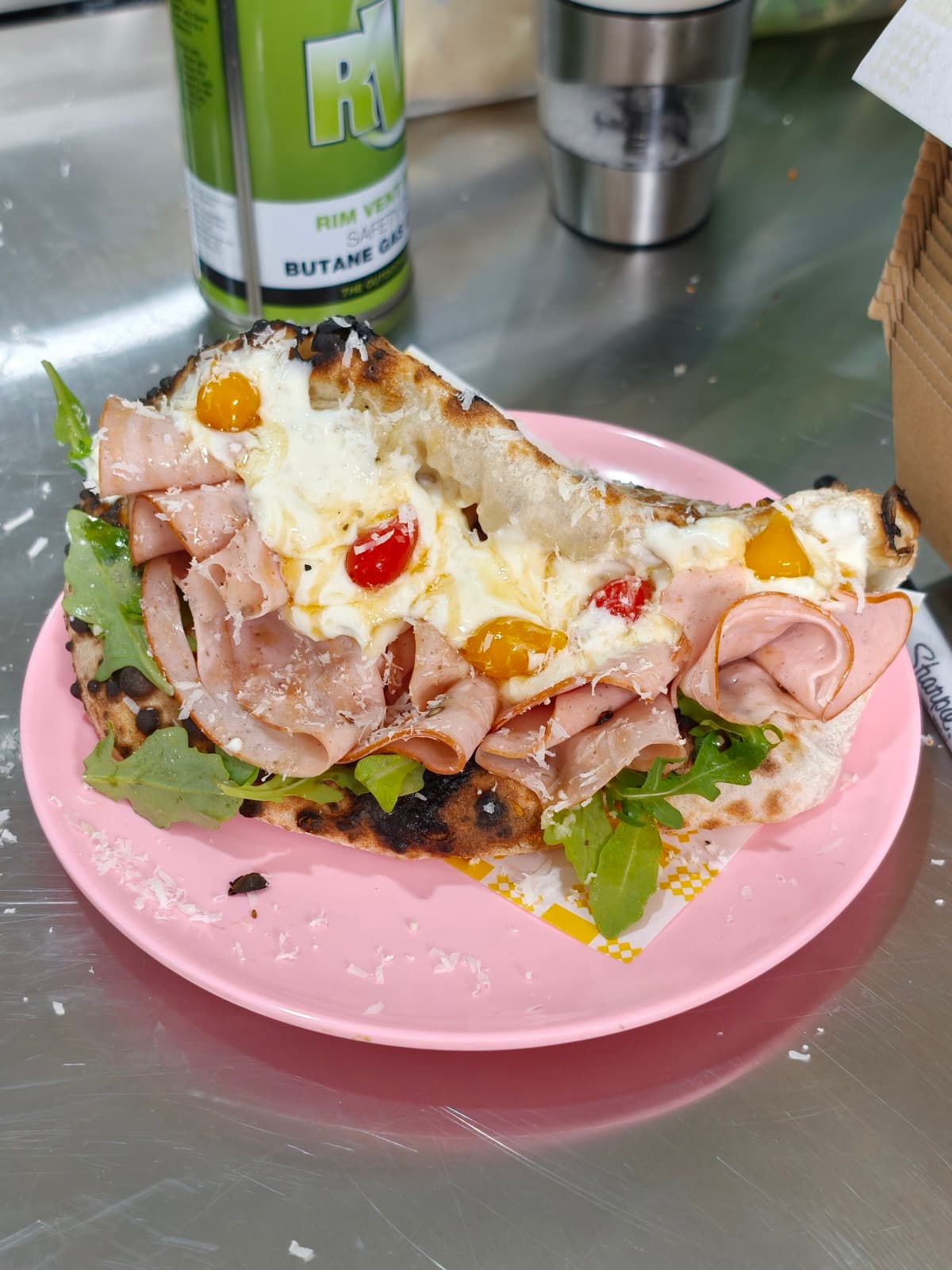
Spicy Salami: the Pizzino we made for the people who order pepperoni and aren't sorry
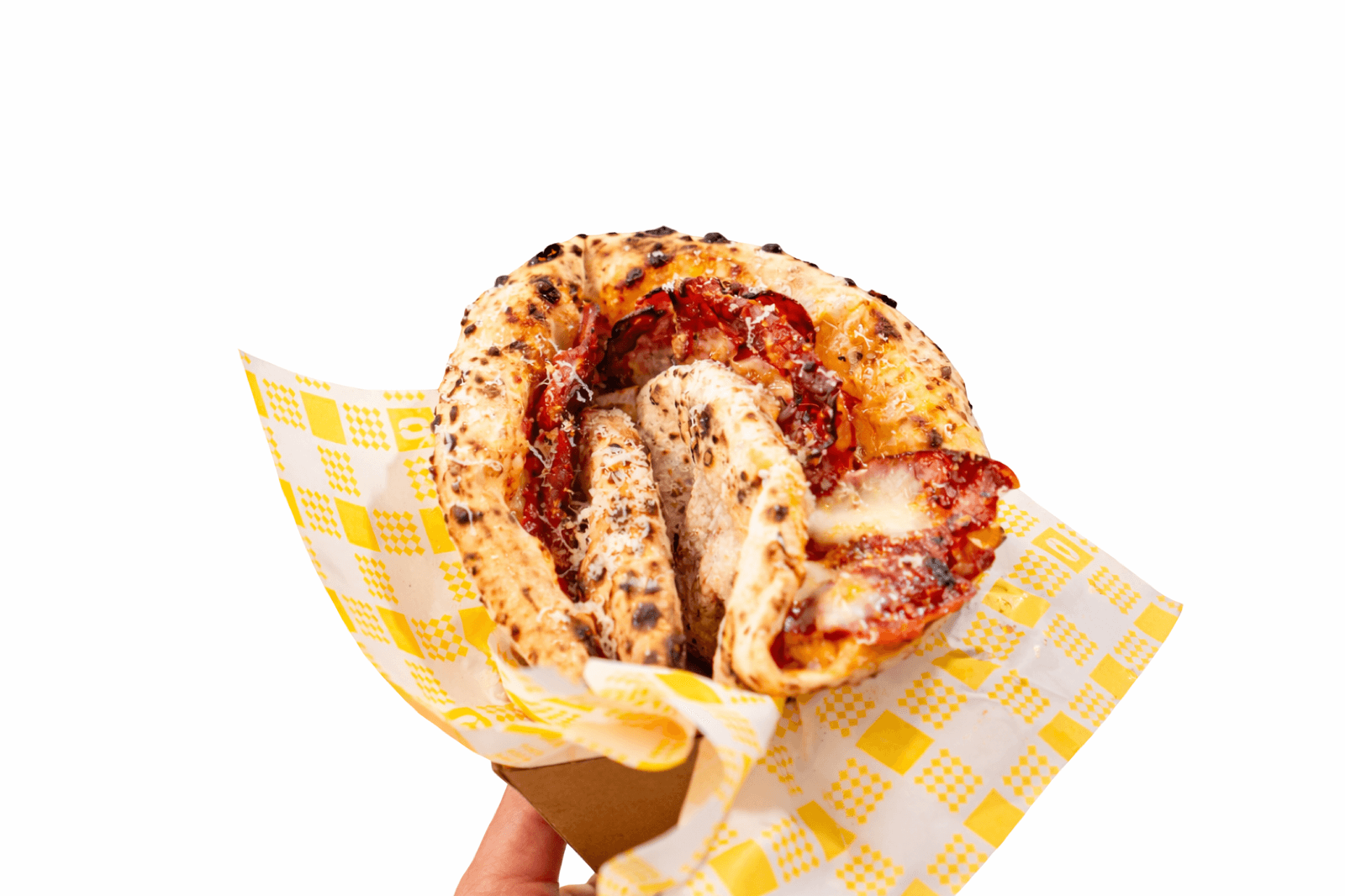
Salami Calabrese, San Marzano sauce, fior di latte. Three ingredients done with care. It's the Pizzino for the chilli crowd, and the one we'd order on a tired Tuesday.
There is a particular kind of Pizzino-eater (and pizza-eater) for whom the only correct topping is "the spicy one".
We see you. We respect you. We made this for you.
The Spicy Salami is the most ordered Pizzino at our Pyrmont shop on weekday lunches. It's the one that gets ordered when somebody walks in, glances at the board, and says "just give me the spicy one." We never get tired of hearing that.
Salami Calabrese, not pepperoni
There's a small linguistic point here that matters.
What North Americans call "pepperoni" is an Italian-American invention: a cured pork sausage with paprika, salt, anise or fennel, garlic, sometimes powdered milk or other binders. It was developed by Italian immigrants in New York around 1900. It's a great sausage. It has an Italian name but it is not an Italian product. (Ask for "pepperoni" in Italy and you'll get capsicum.)
What we use is Salami Calabrese — the original southern Italian dry-cured pork salami that the American version was loosely based on. Difference:
- Calabrese is made with significantly more Calabrian chilli (peperoncino), giving it a deeper red colour and a slow-build heat instead of a sharp top-note paprika hit
- It's drier, more concentrated, more aggressive
- It's cured with traditional spices, not flavour additives
- The fat distribution is coarser — you see distinct cubes of fat in the slice rather than the emulsified meat-and-fat texture of pepperoni
It tastes like the older, wilder cousin of pepperoni. If you've only ever had supermarket pepperoni and you try Salami Calabrese for the first time, the difference is immediate.
We get ours from a producer in Norton Summit, South Australia, who works in the Calabrian tradition using imported peperoncino and South Australian heritage-breed pork. Sliced thin enough to curl into cups when the heat hits.
The cupped salami pattern
This is a small thing that pizza obsessives will know and everyone else will appreciate once it's pointed out.
When the right kind of dry-cured salami is sliced at the right thickness and laid flat on a pizza, the heat causes the edges to lift while the centre stays down. The slice curls into a tiny bowl. The fat renders into the bowl. Some of the fat overflows and turns dark and almost crispy at the edge.
These little salami cups are the best part of the Pizzino. They each hold a tiny pool of rendered chilli-spiced fat that you taste in concentrated form when you bite into one.
Most Sydney pizza places use salami that's too thin or too thick to cup properly. Ours cups. We test it.
The sauce and cheese
San Marzano DOP tomatoes, crushed by hand, salt, oil — same sauce as the Margherita Madness. We don't make a different sauce for a different Pizzino. The sauce is good; we trust it to do its job across every red Pizzino we serve.
Fior di latte mozzarella, torn (not sliced), scattered sparingly. The cheese is the bridge between the sauce and the salami. Too much cheese mutes the salami; not enough and the sandwich falls apart.
The bake (one more time)
90 seconds at 380°C. The salami curls into its little cups. The cheese melts and pulls. The crust gets dark in spots, blistered everywhere.
Out of the oven, finished with a single rotation of cracked black pepper across the top. No final olive oil drizzle on this one — the salami is already releasing enough chilli-spiced oil into the slice that more would tip it over.
How spicy is it, actually
Salami Calabrese is medium-heat by Italian standards, which translates to "warm-lipped, slightly sweating" by Australian sensibilities.
It is less spicy than the Porky Party (which uses 'nduja, a spreadable form of Calabrese chilli concentrate that hits much harder).
It is more spicy than the Hot Honey Havoc (which uses fermented honey + mild heat).
If you can eat a vindaloo without water, this Pizzino will not challenge you. If you order korma at Indian, please order something else.
What it costs and where to eat it
$18 at both shops. Mid-price for our Pizzinos — the salami is the cost driver, and we won't downgrade it.
Eat it warm. Eat the curled salami cups first if you're a methodical eater. Eat them last if you're a saver. There is no wrong way to eat the curled salami cups.
Pair with sparkling water (the bubbles cut the fat) or a cold lager. We're not a bar but we'll point you at the drinks fridge if you ask.
Why we put it on
Because every menu needs the sandwich (or Pizzino) for the day that asked for something familiar.
The Spicy Salami isn't reinventing anything. It's not pushing the conversation forward. It's not telling a story about cross-cultural Mediterranean traditions or vegan-by-default thinking or how we source seasonal asparagus.
It's a salami-and-cheese Pizzino. We make it properly, with real Calabrese instead of supermarket pepperoni, on a 72-hour fermented base, in a wood oven, finished with cracked pepper.
That's it. That's the whole pitch.
Some days you want a sandwich that asks you to think. Other days you want a sandwich that asks you to bite.
This is for the second kind of day. And honestly, half our days are the second kind of day.
That 72-hour fermented base is the same dough as our Ozzo — different shape, same patience. Read the bread story →
Order at Pyrmont or Marrickville →
More from the journal
Very Saucy Meatballs: the meatball sub, taken seriously
Holly Birria: slow-braised beef, a crisp Ozzo, and a dip you pour