Hellenic Hype: a Greek salad that grew up and got opinions
We made the Greek sandwich we always wanted to eat — za'atar-rubbed halal chicken, sharp feta, a salad that won't apologise, and a vegan version that's the real one, not the leftover one.
There's a sandwich on our menu that started life as a fight at the bench.
One of us wanted a Greek souvlaki. The straight version. Chicken, tzatziki, salad, wrap it up, done. Don't overthink it.
The other wanted to ask the hard question: why is za'atar — a spice mix from a few hundred kilometres east of Athens — almost never on a "Greek" sandwich? Why do we draw the lines we draw? What if the Mediterranean was actually one bench, one fire, one conversation?
That sandwich is the Hellenic Hype.
What's actually in it
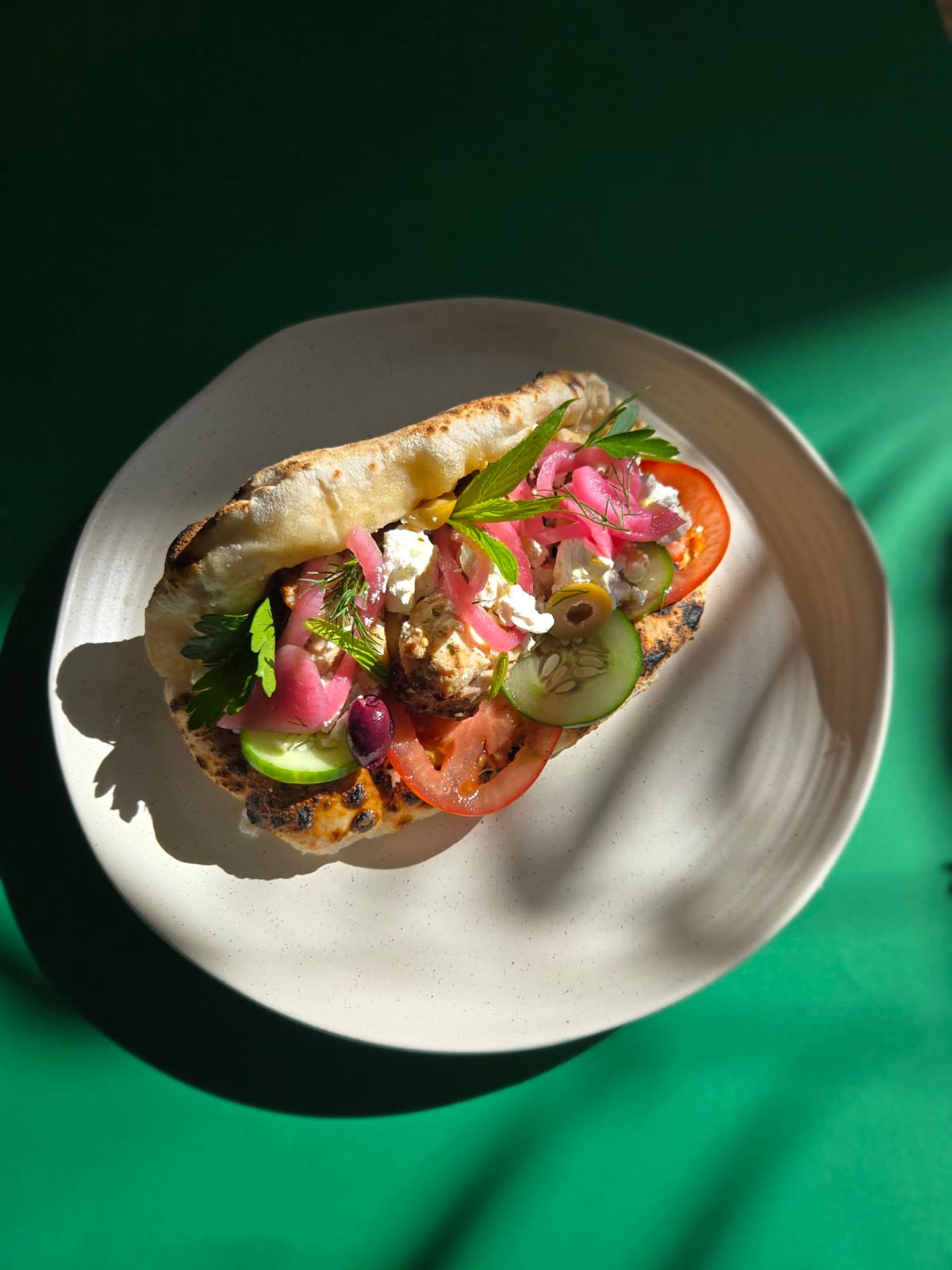
Za'atar-rubbed halal chicken. Grilled fresh, not pulled out of a cryovac bag. The za'atar — wild thyme, sumac, sesame, salt — goes on before the fire, not after. It blooms on the grill and tastes nothing like the dry tin in your spice rack. The chicken is locally sourced, halal, and the rub is from a producer in Lakemba who's been doing this since before "Mediterranean" was a marketing word.
Feta that fights back. Not the soft-spread cubed stuff. The kind that cracks when you press it, salts like the Aegean, and refuses to be polite. It carries the sandwich.
Greek salad. Real one. Cucumber, tomato (Sandhurst, semi-dried for sweetness depth), red onion (briefly pickled so it doesn't bully your palate), Kalamata olives, oregano. No lettuce. Lettuce is what Greek salads have when someone gave up.
Fresh herbs. Parsley, dill, mint — whichever combination the day calls for. Loose, in handfuls, on top. The kind of herb dose that changes the whole sandwich.
The vegan question
We don't believe in second-class options.
If someone in your group is vegan or vegetarian and you order the table together, they shouldn't end up watching everyone else eat the real sandwich while they pick at a downgrade. That's how most kitchens do it. We're not doing that.
The vegan Hellenic Hype is char-grilled cauliflower. Cauliflower that's been kissed by serious heat. Salted properly. Treated like the centrepiece it is. Same za'atar. Same feta-or-not call (we have a plant-based feta option — say the word). Same salad, same herbs, same fire.
Two of us at Ozzo eat the cauliflower version when we're not testing. It's not a fallback. It's a different version of the same idea.
The Levantine collision
Here's the part most "Greek" places don't talk about.
The Eastern Mediterranean — Greece, Turkey, Lebanon, Syria, Palestine, Cyprus — has been trading flavours for thousands of years. Phoenicians sailed olive oil from Lebanon to Sicily. Ottoman cooks brought yoghurt and lemon and pine nuts across the whole region. The "Greek" salad you know is half-Turkish if you trace it honestly. The za'atar on this sandwich is from the Levant, but it would taste perfectly at home on the back deck of a taverna in Crete.
Drawing a hard line around "Greek" food is a modern invention. We're not interested in it. We're interested in flavours that grew up together and want to be on the same bread.
The Hellenic Hype is a sandwich that takes the Mediterranean seriously enough to acknowledge it's a region, not a country.
What it costs and where to eat it
$19 at both Pyrmont and Marrickville. Available chicken, vegan (cauliflower), or vegetarian (cauliflower + feta — say it at the counter, we'll sort it).
Eat it warm, in the shop, so the fire is still on it.
If you take it away, eat it within 20 minutes. The bread is alive — it doesn't sit. We didn't make this for tomorrow's lunch box; we made it for this afternoon's hunger.
Why we bother
Because most Greek-leaning sandwiches in Sydney are the same idea, three times. Pita, chicken, tzatziki, done. We respect that sandwich. We just didn't want to make it again.
The Hellenic Hype is the version that asks: what if Greek wasn't a brand but a starting point? What if a sandwich could be a small argument about geography, and history, and who gets to call what theirs?
It's a sandwich. We don't want to oversell it.
But it's also the first time most people who try it say "wait — there's no lettuce?" and then keep eating.
That's how we know it worked.
The bread holding all of this together is the Ozzo. Read the bread story →
Order at Pyrmont or Marrickville →
More from the journal
Very Saucy Meatballs: the meatball sub, taken seriously
Holly Birria: slow-braised beef, a crisp Ozzo, and a dip you pour