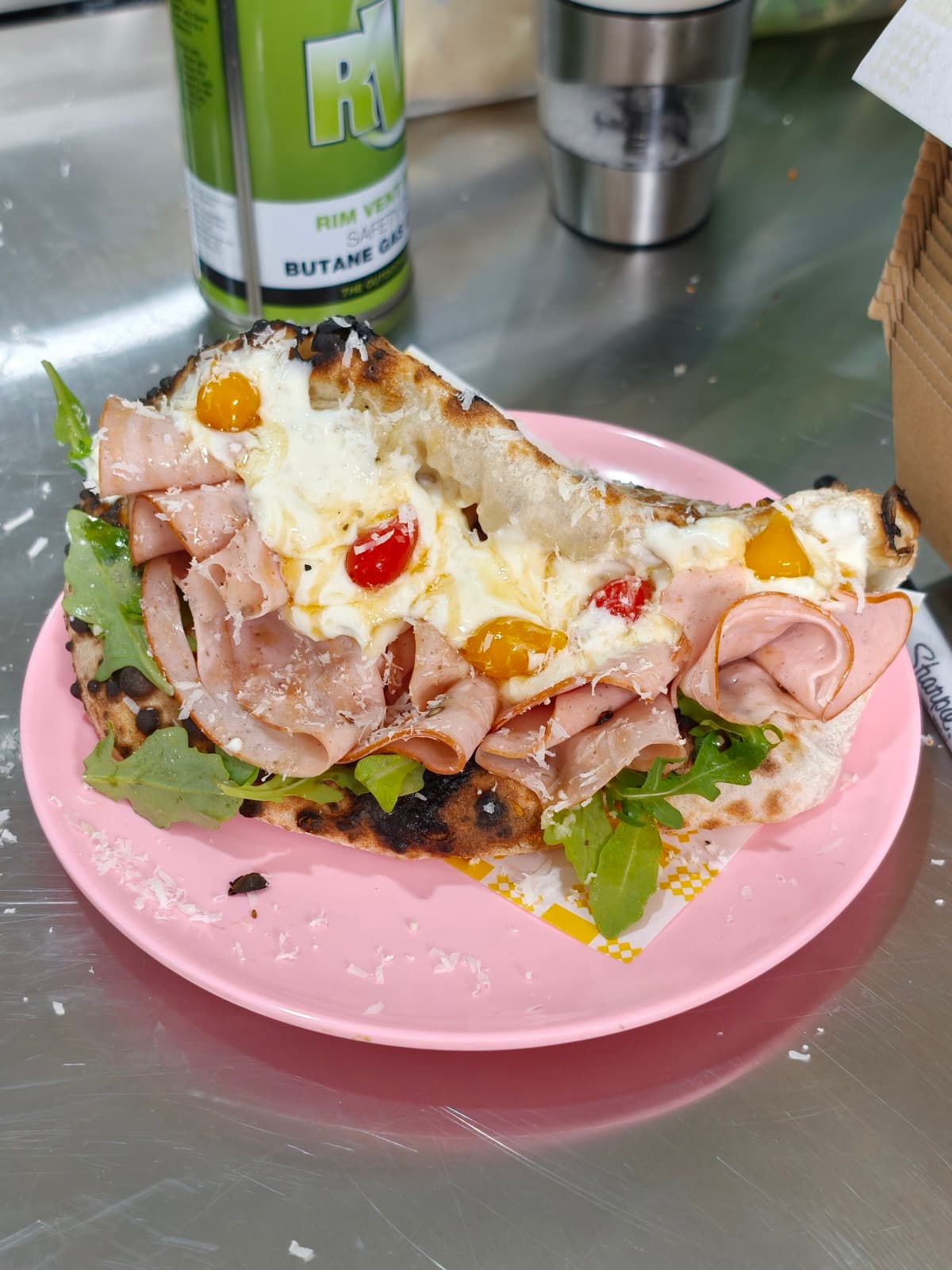
Margherita Madness: the Pizzino that has to be perfect because there's nowhere to hide
San Marzano tomatoes, fior di latte mozzarella, basil, salt, olive oil. Four ingredients. Anyone can list them. Almost no one gets the proportions right. Here's how we think about ours.
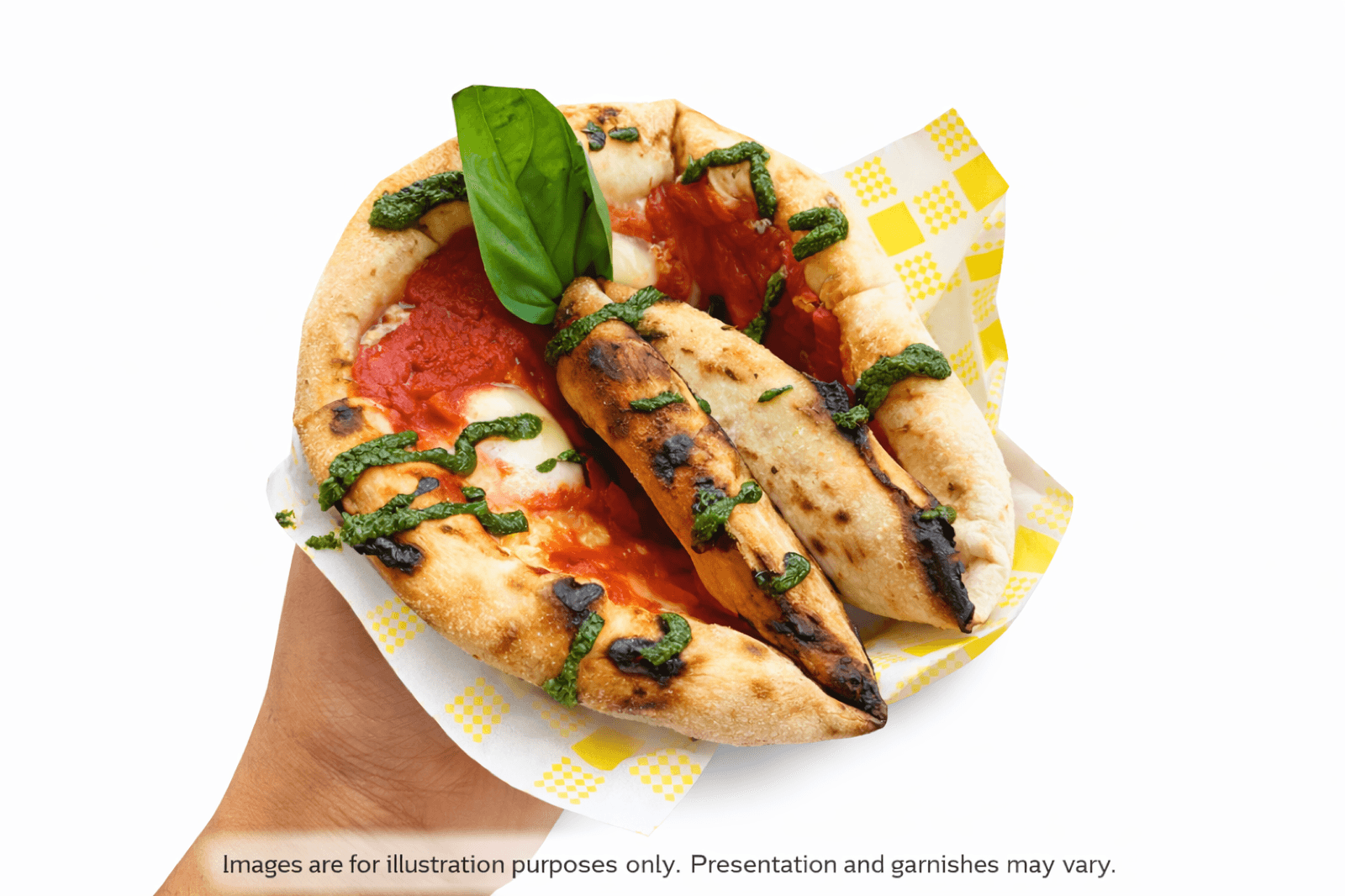
A Margherita is the hardest thing on any pizza menu.
Not the most complex. Not the most expensive. The hardest — because every other pizza has somewhere to hide. Pepperoni hides behind heat and fat. White pizzas hide behind cream. Vegetable pizzas hide behind char and char-marks. A Margherita has nowhere to hide. Four ingredients (five if you count the salt), each one visible, each one tasting like itself.
When a Margherita is good, you taste tomato and cream and herb and salt and bread as distinct things that share a stage.
When a Margherita is bad, you taste sugar from supermarket tomato sauce, rubber from skim mozzarella, dust from dried basil, and not much else.
The Margherita Madness is our attempt at the first version.
The tomato is everything
There is one supplier in the world for the tomato we use, and there is no substitute.
San Marzano DOP — grown in the volcanic ash soil at the foot of Mount Vesuvius, in the Sarno river valley, certified by an Italian government body that counts every can.
These tomatoes are sweeter, less acidic, and meatier than any other plum tomato grown anywhere. The DOP marker means a producer is following the prescribed seed strain, growing region, and processing standards. (There are a lot of cans labelled "San Marzano style" or "San Marzano-type" in Australian supermarkets. None of those are the real thing.)
We open the can. We crush the tomatoes by hand into a bowl. We add a small pinch of fine salt and a drizzle of olive oil. That's the sauce.
No cooking. No reducing. No sugar (the tomatoes are sweet enough). No basil in the sauce (basil goes on after the bake, where it stays alive).
This is the sauce a Neapolitan grandmother would make if you cornered her. We make it the same way she does because she's right.
Fior di latte, not buffalo
Real Neapolitan Margheritas use buffalo mozzarella — mozzarella di bufala. We don't, and we have a reason.
Buffalo mozzarella has a much higher water content than cow's milk mozzarella. On a wood-fired pizza that bakes for 90 seconds at 380°C, that water releases dramatically — you get little puddles on the surface and the crust never properly crisps under the cheese.
On a longer, lower bake (like a New York slice), you can get away with it. On our Pizzino bake, the water is the enemy.
So we use fior di latte — Italian cow's milk mozzarella, lower water content, melts in pulls rather than puddles, holds the structure of the slice.
We tear it (not slice) and scatter it sparingly across the sauce. Sparingly is the operative word. Too much cheese and you can't taste the tomato. Most pizzerias in Sydney use about 50% more cheese than they need to.
The basil layer
Fresh basil. Whole leaves. Goes on after the bake, not before.
Before-the-bake basil burns. Burnt basil tastes like dust. After-the-bake basil stays bright green, releases its oils into the heat of the just-baked Pizzino, and turns the whole thing into something alive.
We grow basil on the back roof of our Marrickville shop. In summer, the basil on your Pizzino was on a plant 30 metres away that morning. In winter, we buy from a hothouse in the Hawkesbury Valley.
The olive oil
Sicilian, single-origin, cold-pressed, finished raw on the hot Pizzino as it comes out of the oven. The heat of the bake activates the oil's grassy, peppery character. This is the smell that hits you when the Pizzino lands on the table.
We do not cook with this oil. (Cooking oil is a different supply. This one is too good — and too expensive — to be heated.)
The salt
Sea salt flakes. Pinch on the sauce before the bake. Second pinch on the finished Pizzino, after the olive oil drizzle.
Two stages. The first salt builds into the sauce. The second salt sits on top in distinct grains that you taste as crystalline bursts. You need both.
What about the optional pesto?
We offer pesto on the menu as a +$1 addition. Pesto-on-Margherita is a slightly polarising idea — purists will tell you not to do it.
Our pesto is house-made: basil, pine nuts, Parmigiano, garlic, olive oil, salt. Pounded in a mortar (the only way to make pesto if you actually care — blenders bruise the basil and turn it bitter).
Adding pesto to a Margherita doubles down on the basil layer and adds richness from the pine nuts. It's a different Pizzino. Not better, not worse. We add the pesto only if you ask.
If you've never had a Margherita where you can taste each ingredient as a separate, intentional choice, try the version without pesto first. Then come back for the version with.
The bake (again)
This part is exactly the same as the Hot Honey Havoc and every other Pizzino: 90 seconds at 380°C in the wood oven. The crust gets dark in places, blistered everywhere, charred at the bubble peaks. The bottom comes out marked with the leoparding pattern that good pizza people use to judge crust quality.
If the bottom of your Pizzino isn't spotty-black, the oven wasn't hot enough.
What it costs and where to eat it
$15. The cheapest Pizzino on the menu, because the ingredients are the simplest.
It's also the Pizzino we recommend to first-time visitors — if you want to understand what we're trying to do as a kitchen. The Margherita Madness is the Pizzino where our work is most visible. Every choice we made on every other Pizzino started here.
Why "madness"
Because making a Margherita that's actually good is borderline obsessive behaviour, and we're proud of that.
A small kitchen, a single can of DOP tomatoes opened that morning, fior di latte torn by hand, basil grown thirty metres away, olive oil that costs more per litre than a glass of wine, salt thrown twice with intent.
For a $15 Pizzino.
It's mad. It's also the right amount of mad. The Margherita is the dish that tells you whether a kitchen is paying attention. We're paying attention.
If you want a chaotic, indulgent, over-the-top Pizzino with twelve toppings — that's the Hot Honey Havoc with mortadella. We salute you.
But if you want the dish that proves we know what we're doing — order this one.
The base is the same 72-hour dough as our Ozzo — different shape, same obsession. Read the bread story →
Order at Pyrmont or Marrickville →
More from the journal
Very Saucy Meatballs: the meatball sub, taken seriously
Holly Birria: slow-braised beef, a crisp Ozzo, and a dip you pour