Za'atar & Olives: the Pizzino with the shortest ingredient list and the longest story
Za'atar, olive oil, olives, salt. Four ingredients on bread. A whole region's tradition in eight bites. Why the simplest Pizzino on our menu is also the one we're proudest of.
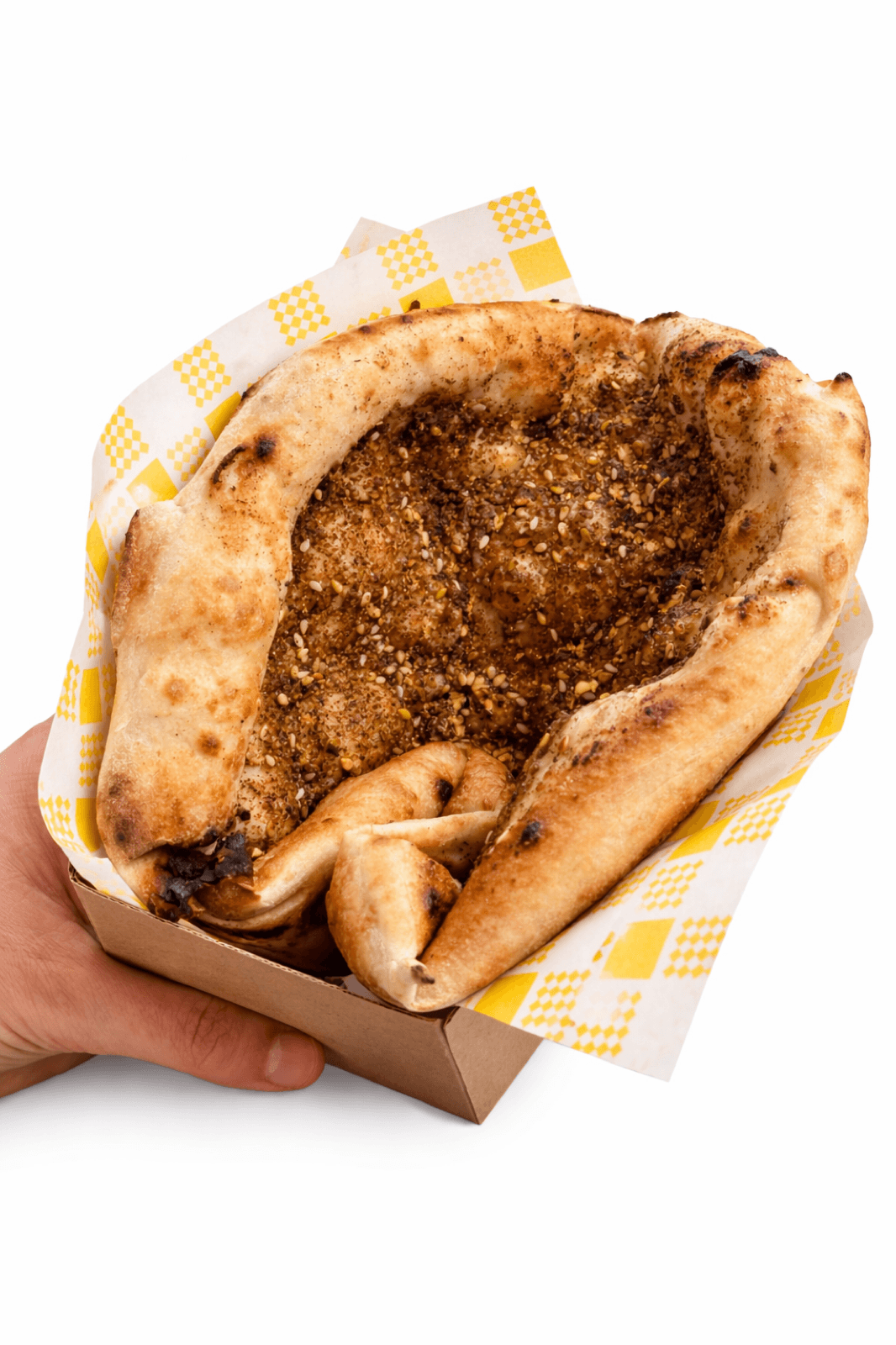
The Za'atar & Olives Pizzino has four ingredients. None of them is cheese.
If you've never eaten a Pizzino without cheese, that probably sounds wrong. It sounded wrong to us too, the first time we put it on. We added it expecting people to skip it.
It's now one of our top three sellers in both shops.
Here's why.
The Levantine bread tradition
There's a whole family of breads in the Levant — Lebanon, Syria, Palestine, Jordan, parts of Turkey — that are flat, fired hot, and topped with za'atar and olive oil. It's called manakeesh (or manaqish, or manousheh, depending on where you grew up).
You can buy manakeesh on the street in Beirut and Damascus and Amman from 7am. It's breakfast. It's morning tea. It's the smell that hits you when you walk past a bakery in the older parts of those cities.
The base is a thin disc of bread, often heavier on yeast and lighter on time than Italian pizza dough. The topping is za'atar — a spice mix of wild thyme, sumac, sesame seeds, and salt — combined with olive oil into a thick green-brown paste that gets brushed across the dough before it goes into the oven.
That's it. No cheese. No tomato. Just bread + herb + oil.
It's been the staple of Levantine breakfast for at least a thousand years.
What we kept and what we changed
We kept:
- The za'atar paste, made the right way (good spice, good oil, no preservatives)
- The bake — hard, fast, hot
- The minimalism of the topping
We changed:
- The bread base. Manakeesh dough is good. Our 72-hour fermented Pizzino base is, in our humble opinion, better — it has more sour complexity from the longer ferment, and the crust gets the blistered leoparding that Italian wood-oven bread is known for. Levantine purists will disagree. We're at peace with the disagreement.
- We add olives. Most manakeesh doesn't include them; you'd eat olives on the side. We chose to put them on the bread so the salt-brine flavour bakes into the za'atar paste.
- We finish with raw olive oil. A street manakeesh in Beirut usually doesn't get the finish — the cooked oil in the paste is enough. We add the second drizzle because our oil is good enough to deserve a second appearance.
The za'atar
There are about a thousand za'atar blends. Every region, every family, sometimes every household has a different ratio.
We use a Palestinian-style blend: more sumac than most Lebanese versions, less salt than commercial Australian supermarket za'atar, and the herb is zaatar (wild Mediterranean hyssop) rather than dried thyme. The difference is large. Thyme is one note; wild zaatar is herbal-medicinal-floral all at once.
We get the spice from a family-run importer in Greenacre (Sydney's Lebanese diaspora hub). They're not the cheapest. They're the only ones we'll use.
The paste: za'atar + olive oil, 1:1.5 by volume. Stirred until it's a thick, paintable consistency. Spread across the Pizzino base with the back of a spoon, edge to edge, generous.
The olives
Kalamata, pitted, halved.
A Lebanese baker might use cracked green olives in brine. A Syrian baker might use small black wrinkled olives. We tested both. We landed on Kalamata because:
- They're widely available in Sydney, so we can be consistent
- They have the right size — small enough to bake into the paste without dominating, large enough to give a meaningful bite of olive
- The fruit-sweet of a good Kalamata balances the sumac-tart in the za'atar in a way the saltier black olives don't
Six halves per Pizzino. Scattered, not centred. Some bites have olive, some don't. That variation is part of the experience.
The bake
90 seconds at 380°C in the wood oven, like every Pizzino.
The za'atar paste bubbles. The olives soften and concentrate. The sesame seeds in the za'atar toast and pop. The bread crisps at the edges.
Out of the oven, finished with a drizzle of raw olive oil and a small pinch of flaky salt.
What it costs and where to eat it
$15. Cheapest Pizzino, tied with the Margherita.
It is also our only fully vegan Pizzino as standard. No swap needed. No "vegan version". If you eat plants, this is the one.
Both shops. Eat it warm. Don't fold it like a slice — the toppings will slide off. Eat it flat, with two hands, the way you would eat a piece of manakeesh.
Why we put it on
Because we wanted at least one Pizzino on the menu where the toppings list was so short you could memorise it from across the room.
Because we wanted to put a Levantine bread tradition on the same menu as Italian flatbreads, side by side, neighbours rather than competitors. The Mediterranean is one region with many traditions. A menu that only honours one of them is missing the point.
Because every menu should have a sandwich (or, in this case, a Pizzino) that's quiet enough to be the thing you order on the day you don't want to be impressed. A bread and a paste and a few olives. Eaten warm. In eight bites.
Sometimes the best food is the food that's stopped trying to prove anything.
This is that Pizzino.
A bread, a paste, a few olives — the bread is our Ozzo dough. Read the bread story →
Order at Pyrmont or Marrickville →
More from the journal
Very Saucy Meatballs: the meatball sub, taken seriously
Holly Birria: slow-braised beef, a crisp Ozzo, and a dip you pour